

Is KLM saving its future, or mainly its past?
Who is protecting KLM: individual interests or a shared future?

You can be proud of a company and still believe it is getting in its own way. That is precisely what troubles me about KLM. An impressive history, skilled people and a global network. Yet for years the discussion has revolved around costs, employment conditions, independence and the next reorganisation.
As a passenger, you simply want good service. As a cargo customer, you want commitments honoured and someone to take responsibility when things go wrong. The perception of a distant, sometimes arrogant organisation, which concerns me particularly around cargo, deserves serious investigation. It is not a proven judgement about every employee or customer relationship. But anyone dismissing such signals by pointing to their reputation misses the point.
National pride will not bring your suitcase back. And a delayed shipment gains little from a lesson in Dutch aviation history.
The real challenge is to turn protected sectional interests back into shared responsibility. Financial discipline and customer-focused behaviour must reinforce each other.
KLM wants to secure its future. The question is which habits, agreements and identities help it do so, and which mainly protect the past. Can you truly renew a business if everyone wants to retain their own exceptions?
It started with entrepreneurship
KLM was founded in 1919 by eight investors from business and banking, with Albert Plesman at the helm. Scheduled services between Amsterdam and London followed in 1920, a trial flight to Batavia, now Jakarta, in 1924, and scheduled services to New York in 1946.[1] Early long-haul flights involved stops. They were the forerunners of the network that would later give the Netherlands so many direct connections.
That took courage: developing markets, investing and taking risks. Trade, colonial relations and aviation policy also played a role. But entrepreneurship remains an essential part of the story. People built connections that did not yet exist.
The question is whether that mentality survives when a pioneer becomes an established institution. Pride helps when it encourages better performance. It becomes misplaced when it means: we are important, so the world must accommodate us.
A route map is not a museum collection. You have to keep developing it.
Making a profit does not mean you can fund the future
It would be wrong to portray KLM as a company that only makes losses. Its operating margin was 8.8% in 2017 and 9.8% in the original publication for 2018.[2][3] For 2025, KLM Group reported operating income of €416 million and a margin of 3.2%. Air France achieved 6.7% in the same group reporting.[4]
KLM Group also recorded net profit of €284 million in 2025. At the same time, its cash-flow statement shows €1.222 billion in aircraft purchases. Under KLM’s definition, free cash flow was €85 million. After €176 million in net interest payments and €327 million in lease repayments, adjusted free cash flow was negative €418 million.[5]
That negative figure is therefore not an annual loss. It shows why profit alone tells us too little about the capacity to renew the business. Nor can investments simply be deducted from net profit, which already includes depreciation.
For the first nine months of 2026, operating income improved to €526 million, compared with €328 million in the comparative 2025 figures restated for IFRS 18.[6] There is a recovery. The task remains to earn enough consistently to fund new aircraft, reliable service and setbacks.
The financial question and the cultural question therefore belong together. Poor cooperation can cost money. A healthy culture must ultimately prove itself in results.
Calling an acquisition something else does not make it a marriage of equals
We should also be clear about 2004. Air France acquired KLM through a share exchange. The existing Air France company subsequently became the Air France-KLM holding company, while Air France’s flight operations were transferred to a subsidiary. Air France and KLM have since operated as separate airlines within the group.[7]
The term ‘combination’ describes the resulting group. It should not obscure the fact that the transaction was an acquisition of KLM. Equally, today’s holding company is different from the operating airline Air France. That precision prevents national sensitivities from replacing an understanding of the corporate structure.
Under Leo van Wijk, the combination was intended to strengthen competitiveness and the network’s position. The prospects of remaining independent were not particularly promising at the time.[8][9] A joint strategy now exists too.[10] But a strategy on paper is only worth something when decisions about people, resources and investments follow it.
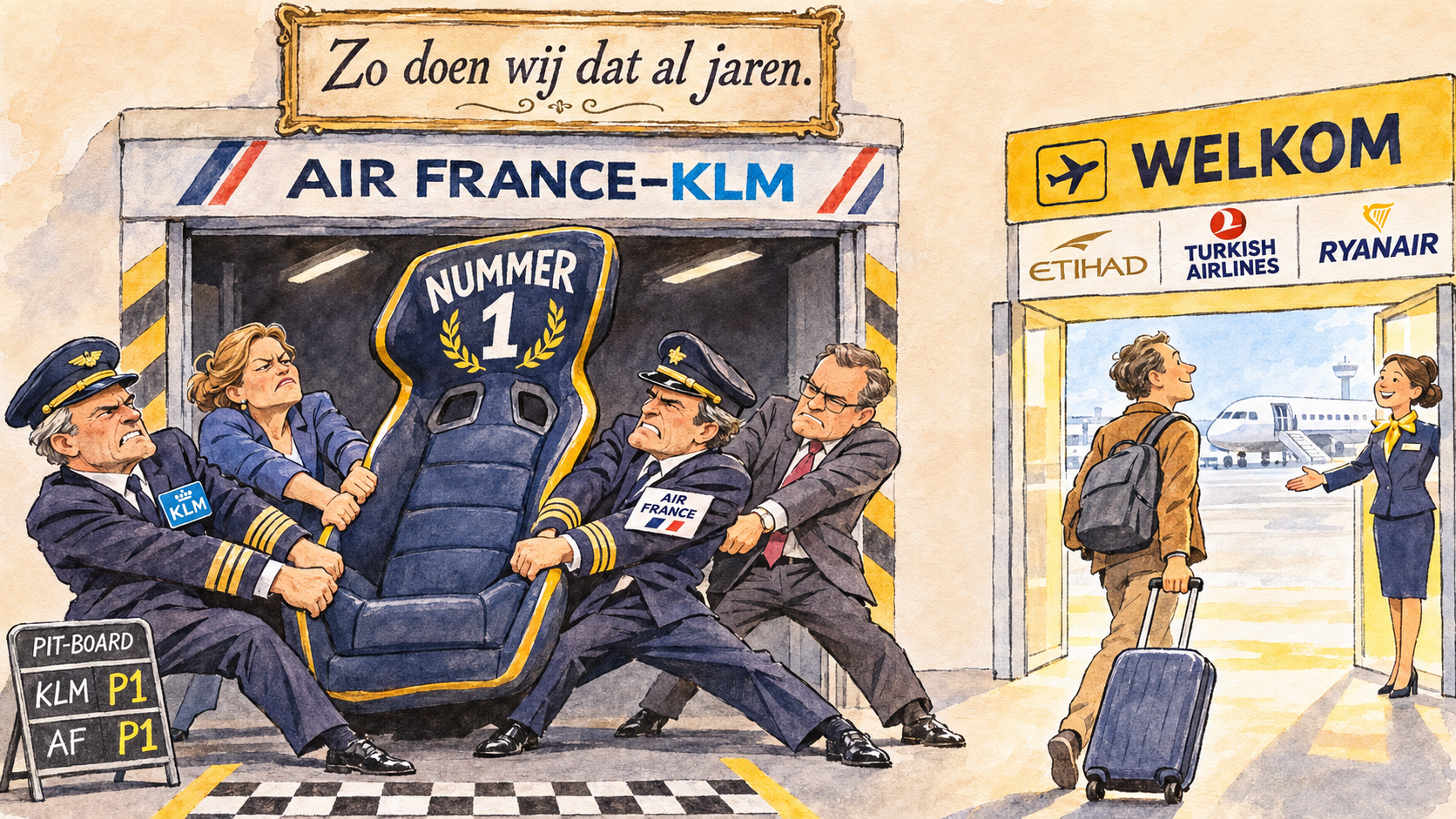
After the Mexican Grand Prix, I was left with the image of two drivers who both believe they are entitled to the number-one position. As a management analogy, it fits uncomfortably well: while the team discusses its pecking order, a competitor drives past.
Two brands can make commercial sense. Two organisations that put being right ahead of their shared performance do not.
‘Us and them’ is not a business model
The pilots make this tension visible. Their strong organisation and bargaining position have value for their members. In 2023, the Dutch state agent described relatively high pay, lower deployment in the comparison examined and collective-agreement provisions that restricted management’s room to act.[11] KLM and the unions disputed parts of that report.[12][13] It is therefore not a current global ranking of employment conditions, but it does provide grounds for critically reviewing agreements.
Safety, health and professional expertise deserve protection. Good employment conditions are legitimate. The question is whether every historical agreement still contributes to a healthy company, and whether it can change when necessary.
The same test applies to executive pay, management layers and office fiefdoms. Those asking for sacrifices must show which of their own exceptions will disappear. A board that has accepted agreements for years cannot place responsibility for change solely on the union.
Delta, with which KLM has had a transatlantic joint venture since 2009, demonstrates that strong pilot unions and good results are not automatically incompatible.[14] Delta reported a 2025 operating margin of 9.2% under US accounting rules; its pilots had agreed a contract with substantial pay rises in 2023.[15][16] The market and revenue mix differ, but the simple story that ‘the union is the problem’ does not hold up.
My position is practical: assess agreements against safety, customer value, productivity and the future of the whole business. Involve employees in improvements and give them responsibility for the outcome too.
‘They must change so that we can stay put’ is not a recovery strategy.
A strong network requires choices
KLM cannot treat its destinations as isolated shops. A feeder route may supply passengers for other flights. Dropping a destination can therefore have effects beyond its own route budget. At the same time, KLM itself says it adds new destinations and cancels less profitable routes.[17]
Protect the network’s coherence, but do not declare every connection sacred. Examine customer demand, contributions to connecting flights, frequency, aircraft size and partnerships. Give a new market time, with agreed investment limits and review dates.
Etihad carried 22.4 million passengers in 2025, 21% more than the year before, and reported net profit of AED 2.6 billion.[18] That is not a directly comparable operating margin. It does show that others are building scale. KLM must keep earning its place at the big table.
Schiphol belongs in that task. Passengers and cargo customers experience one chain, even when different companies operate its parts. The joint trial of autonomous baggage transport shows that cooperation is possible.[19] The measure should be the whole customer journey: who solves the problem, even when it starts outside their own department?
Do we dare question even the name?
In 2023, T-Mobile Netherlands and Tele2 mobile continued under the name Odido. A new brand identity and positioning were introduced.[20] That does not prove a successful cultural transformation. It does show that familiar names can be relinquished to create a shared story.
Should Air France-KLM investigate such a move? Yes. As a serious strategic option, rather than an expensive distraction. Keeping both brands should be evaluated honestly too. A familiar name can attract customers; internally, it can also become a flag under which exceptions are defended.
Investigate what the names actually deliver: customer preference, repeat purchases, willingness to pay and commercial access. Weigh that against the costs and risks of transition and any benefits of one identity. Recognition is not automatically loyalty. Employee pride is not the same as customer value either.
The disappearance of a brand need not mean the disappearance of Schiphol as a hub or of Dutch connections. Conversely, keeping the blue name does not guarantee that network. Traffic rights, licences and legal structures require separate scrutiny; a new logo cannot resolve them.[9][21]
With governments as shareholders, public interests matter.[22] My view: protect connectivity and economic value, but do not use those interests as a licence to preserve every national exception.
A new name on an aircraft with the same internal tribalism is mainly good news for the painter. A new identity only becomes meaningful when decision-making, cooperation and rewards change with it.
Rintel’s task: make shared interests governable
On 5 November, KLM announced fleet simplification, productivity improvements and more cooperation within the group.[23] KLM refers to around 5,000 jobs being organised differently, partly through outsourcing and partly through transfers to Air France-KLM. Around 1,000 fewer jobs are attributed to productivity improvements. This is substantial, but it is not the same as 5,000 people losing their work. KLM expects to manage the staffing consequences through natural attrition, voluntary measures and redeployment. That deserves recognition. The question is whether Rintel and the group’s leadership can connect implementation with behaviour that customers actually notice.
I expect three connected choices from them:
- One customer promise across the chain. Make clear what passengers and cargo customers can expect, especially during disruption. Give someone the authority to solve problems across departmental boundaries.
- One yardstick for investments and exceptions. Assess routes, fleet, collective agreements and management structures by their contribution to safety, customer value and sustainable returns. Show how renewal will be funded.
- One approach to taking responsibility. Reward shared performance, address obstruction consistently and review customer feedback, reliability, productivity and cash flow every quarter. Examine the brand choice without declaring one outcome sacred in advance.
Operational experience is essential. Those keeping aircraft, cargo, baggage and rosters moving every day know where a saving will cause a more expensive disruption tomorrow. Listening must lead to decisions. Otherwise, we raise a glass, take a comfort break and find that only the meeting table has moved.
Can the current leadership do this? The supervisory board must judge that through choices, behaviour and execution. If those fail to materialise, the composition of the boardroom must also be open to discussion.
What kind of pride helps your business move forward?
Perhaps you recognise the same tension in your company: an old trading name, an untouchable department or a colleague to whom different rules apply. Organisational culture becomes visible in what you reward, tolerate and dare to change.
On Monday, choose one recurring customer problem with your management team that keeps falling between departments. Identify which agreement blocks a solution. Give one person authority to change it and assess after thirty days whether customers notice a difference. That is ownership. If useful, record the objective, actions and measures in an OGSM. These glossary links lead to Dutch explanations.
Rintel does not need to erase KLM’s history. She needs to prevent protecting that history from becoming more important than building its future.
Do we have the courage to let go of what once made us great when it now holds us back?
Ei Openers. We challenge you to take a stand.
Sources
- KLM history. Company history; used for milestones, not as independent evidence of management quality.
- KLM record result 2017.
- KLM annual figures 2018. Original publication, not a later restatement.
- Air France-KLM full-year results 2025. Company results distributed through MarketScreener; not independent analysis.
- KLM Annual Report 2025. Cash-flow statement, p. 90. Adjusted free cash flow follows net interest and lease repayments.
- KLM third-quarter results 2026. Interim figures; comparative figures restated.
- Air France-KLM Reference Document 2004.
- Could KLM continue without Air France?.
- Dutch parliamentary paper 35148, no. 3.
- Air France-KLM strategy.
- Fifth report by the Dutch state agent. Historical analysis from 2023, not a current global ranking of employment conditions.
- Union response to the state agent’s report.
- KLM response to the fifth report.
- Launch of the Air France-KLM and Delta joint venture.
- Delta full-year results 2025.
- Delta pilots approve new contract.
- KLM network and alliances.
- Etihad results 2025. Company-reported results; awards and marketing claims are not treated as independent evidence of service quality.
- Next phase of autonomous baggage transport trials. Evidence of cooperation, not proof of improvement for every passenger.
- T-Mobile Netherlands becomes Odido. T-Mobile Netherlands and Tele2 mobile, not Vodafone; evidence of repositioning, not proven cultural change.
- Dutch parliamentary paper 36634, no. 5.
- Evaluation of state shareholdings in Air France-KLM and KLM.
- KLM announces measures. Announced effects are not realised results. Around 5,000 jobs include outsourcing and transfers, not 5,000 dismissals.